
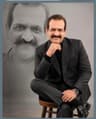

The founders
Richard Bandler. A psychology student at the University of California, Santa Cruz, who, with John Grinder, put NLP together in the early 1970s by modelling therapists Fritz Perls, Virginia Satir and Milton Erickson. Bandler is the field's wild genius: brilliant at observing and codifying patterns, abrasive in person, and later the author of books like "Frogs into Princes" and "The Structure of Magic." The controversies are part of his record: he was charged with murder in 1988 in the death of a sex worker, and after a retrial he was acquitted. He also spent years in legal disputes with Grinder over who owned NLP. His later work (Design Human Engineering, Persuasion Engineering) drifted further from the original methodology.
John Grinder. The linguist half of the founding pair. Grinder contributed the language analysis that made NLP precise: the Meta Model of questions and the Milton Model of hypnotic language. After the split with Bandler, he developed "New Code NLP" with Carmen Bostic St Clair and kept teaching. Grinder's core lesson: language and behaviour follow grammar, and you can learn to read and use that grammar deliberately.
A detail worth dwelling on, because it is the strangest fact in the field's story: Perls, Satir and Erickson could not explain how they did what they did. Their own theories did not match their behaviour, and the teachable patterns had to be extracted by observation. That gap between brilliance and explanation is where NLP was born, and it is why this list of names is really a list of two kinds of people: the geniuses who performed the excellence, and the modellers who coded it.
Robert Dilts. The systematizer. Dilts was an early student of Bandler and Grinder who took modelling further than anyone: strategies, belief systems, the "Disney strategy" (cycling through the dreamer, realist and critic roles), Sleight of Mouth reframes, and a large library of books. If Bandler is the fire and Grinder the structure, Dilts is the mapmaker. Most modern NLP training materials trace back to his work. His best-known contribution, the Logical Levels, gets its own treatment here, including an honest note on its scientific standing.
The famous names you will actually see online
Tony Robbins. Covered in detail in Tony Robbins and NLP. Trained in NLP and hypnosis in Grinder's lineage in the early 1980s, then built the largest motivational brand on Earth on top of anchoring, reframing and state work.
Ross Jeffries. The controversial one. Jeffries built "Speed Seduction" in the 1990s by building directly on NLP language patterns (embedded commands, pacing and leading) and aiming them at pick-up artistry. His work is a standing warning: the same language tools that build rapport can be used to manipulate, and the seduction community's record of harm is real. Learn the patterns; reject the application.
Joe Dispenza. The adjacency case. Dispenza is a chiropractor and author whose books on changing habits and identity (breaking the habit of being yourself) overlap heavily with NLP themes: states, conditioning, visualization, reprogramming. But he is not part of the classical NLP lineage, and his claims about quantum effects and healing go well beyond what NLP itself claims. Search engines link him to NLP because the ideas rhyme, not because he is a product of the Bandler-Grinder tradition. Treat him as adjacent, with extra skepticism about the metaphysics.
Jimmy Carr. The comedian who actually trained. Carr is a British stand-up who studied NLP and hypnosis and talks about it openly. His audience work uses classic patterns: pacing, reframing, reading a room's state. He is a decent proof point that NLP is a communication skill, not a mystical practice: useful to a comedian, useless as a personality cult.
What to learn from each
- From Bandler: notice structure, not just content. What a person does with their attention, imagery and language is more informative than what they say.
- From Grinder: precision. Ask questions that force clarity instead of accepting vague answers.
- From Dilts: method. Codify what works so it can be taught and repeated.
- From Robbins: delivery. How you hold attention and state matters as much as what you say.
- From Jeffries: the ethical line. Skills do not come with a conscience; yours has to supply it.
- From Dispenza: healthy skepticism. Popularity is not evidence.
- From Carr: normalcy. NLP is a toolbox for communication and change, and it belongs in ordinary life.
The useful habit is to study all of them and belong to none: take the skill, skip the hero worship.
Two more threads complete this picture. Satir's contribution to the field deserves more than a mention: how she rebuilt families, and the machinery underneath her warmth, is some of the best material the field borrowed. And the wildest name on the list is also the least retired: what Bandler is still doing now, decades after most founders would have stopped.
The honest through-line
Every famous name in this field is a mix of genuine skill and human mess, sometimes spectacular mess. That is true of any unregulated field built by strong personalities. The lesson is not to find a guru and copy them. It is to learn the underlying skills, check everything against practice and evidence, and keep your own judgment. The history of NLP covers the early years in more depth, and the second generation who kept building is the part of the story most tellings skip. If you want to learn the actual skills rather than collect stories about the people who made them, start with the free webinar or look at the programme.